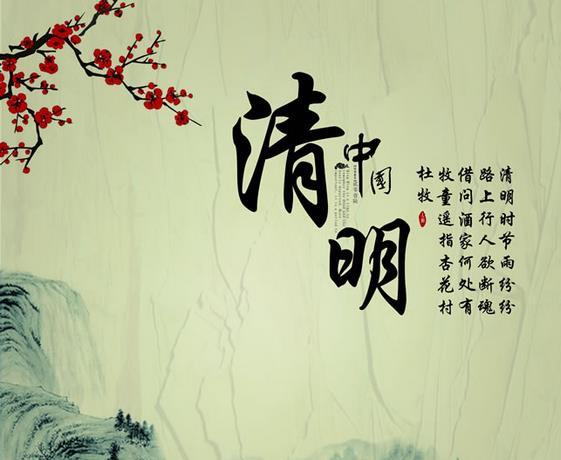
Qing Ming is a time to remember the dead and
the dearly departed. More important, it is a period to honour and to pay
respect to one's deceased ancestors and family members. Because it reinforces the
ethic of filial piety, Qing Ming is a major Chinese festival.
Literally meaning "clear" (Qing) and
"bright" (Ming), this Chinese festival falls in early spring, on the
106th day after the winter solstice. It is a "spring" festival, and
it is an occasion for the whole family to leave the home and to sweep the
graves of their forebears. Chinese being practical people this sweeping of the
graves is given an extended period, that is, 10 days before and after Qing Ming
day. Among some dialect groups a whole month is allocated.
Qing Ming is popularly associated with Jie Zi
Zhui, who lived in Shanxi province in 600 B.C. Legend has it that Jie saved his
starving lord's life by serving a piece of his own leg. When the lord succeeded
in becoming the ruler of a small principality, he invited his faithful follower
to join him. However, Jie declined his invitation, preferring to lead a
hermit's life with his mother in the mountains.
Believing that he could force Jie out by burning
the mountain, the lord ordered his men to set the forest on fire. To his
consternation, Jie chose to remain where he was and was burnt to death. To
commemorate Jie, the lord ordered all fires in every home to be put out on the
anniversary of Jie's death. Thus began the "cold food feast", a day
when no food could be cooked since no fire could be lit.
The "cold food" festival occurs on the
eve of Qing Ming and is often considered as part of the Qing Ming festival. As
time passes, the Qing Ming festival replaced the "cold food"
festival. Whatever practice is observed,the basic
observation of Qing Ming is to remember one's elders by making a special effort
to visit their graves, ashes or ancestral tablets. To make the visit even more
meaningful, some time should be spent to remind the younger members of the
family of the lives and contributions of their ancestors, and the story of Jie
Zi Zhui who choose death over capitulation.